

Mall Coven
Forbidden Fruits

“Goat’s milk, thigh gaps,
rose petals, bone caps,
truffle oil, bitch slap
blood clots, juice press.”
-Induction ceremony chant, Forbidden Fruits, 2026.
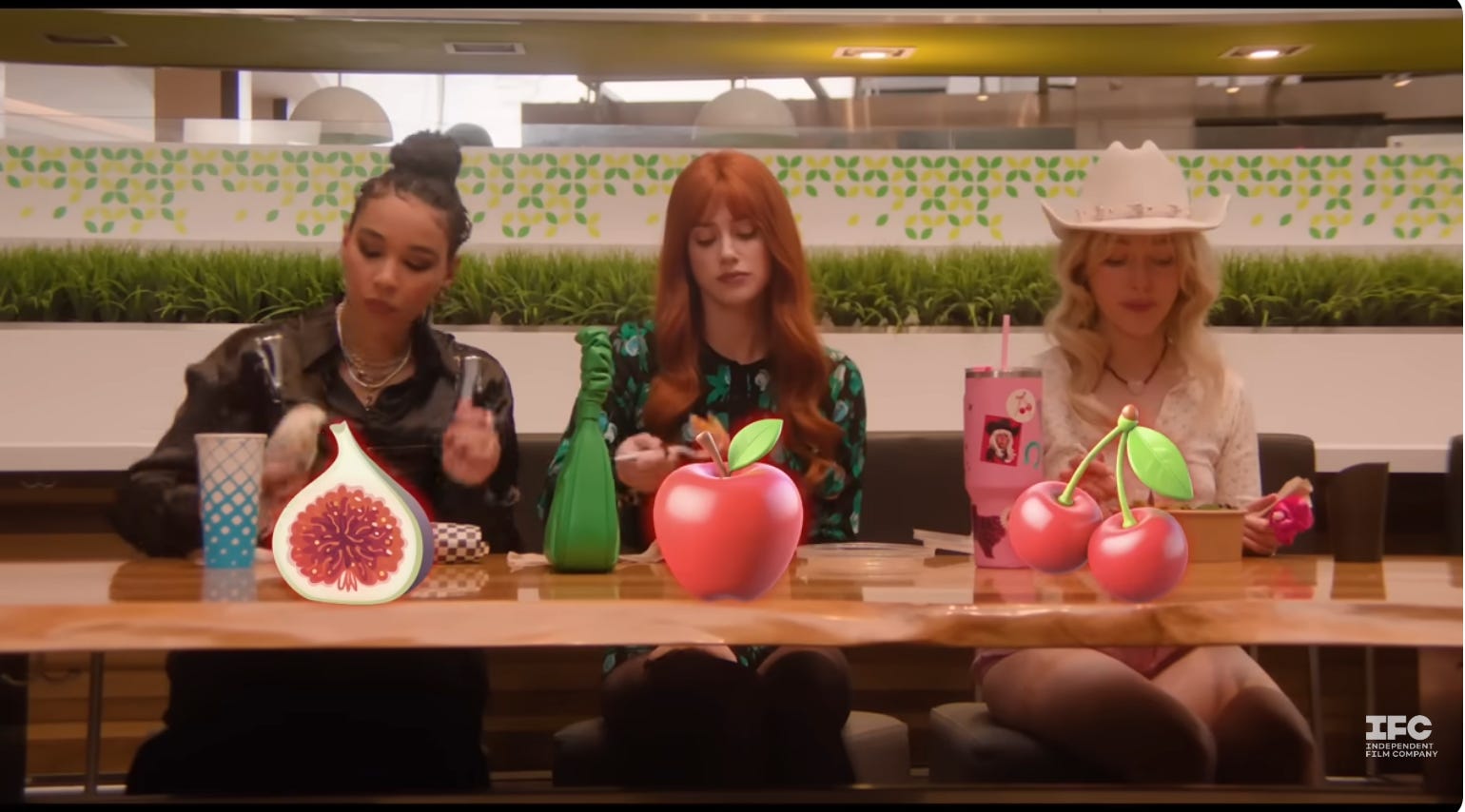
From the opening scenes of Forbidden Fruits, a campy, witchy, satire horror film produced by Diablo Cody, it’s easy to see the influences. This is The Craft (1996) meets Mean Girls (2004) meets Clueless (1995) meets Jawbreaker (1999). Set in a shopping mall, Forbidden Fruits focuses on a trio of friends, Apple (Lili Reinhart), Fig (Alexandra Shipp), and Cherry (Victoria Pedretti), who work in a fictitious women’s apparel store called Free Eden. In addition to being co-workers, they are also secretly witches who use the store after hours to cast spells, control each other’s lives, and enact revenge. Through the course of the film, they recruit and induct new hire Pumpkin, played by Lola Tung.
This fusion of female identity and commerce is achieved through the shopping mall.
The shopping mall, a dying marker of commerce in the United States, serves as an essential setting for this premise. It’s within this highly commercial, female-centric space that the Free Eden ladies are able to erect their own fantastical world with their own witchy rules.
Suspension of disbelief is essential for Forbidden Fruits; this is an alternate, all-female dimension where outside rules do not apply. This division with the outside world is communicated through the singularity of the shopping mall: femmy stores, shopping bags, the food court, and, of course, female friendships set across consumption. The men who do exist in the film wander in and out, sometimes as fleeting romantic and sexual interests, inconsequential to the central premise. The witches’ drama, conflicts, and utmost anxieties remain solidly within their platonic female friendships.

This dynamic is reflected through location. The mall is literally their whole world: the entire film, directed by Meredith Alloway, occurs at the fictitious Highland Place mall1, set in Dallas, Texas23. We seldom see the witches outside of the mall because who they are on the outside is irrelevant. It’s at the mall, with their curated outfits, body mists, competitive female bonds, and astrological references, that Apple, Cherry, and Fig assume their personas. This fusion of female identity and commerce is achieved through the shopping mall.
Perhaps intense, deeply-bonded female friendship set across terrains of capitalism will always be doomed to violence.
Valley girl accents are abound, a choice reflective of young, female communication rather than regional dialect. iPhones and cultural references (“I Googled it”), suggest the witches live in the present day. But their respective personal styles4 and the mall’s stores imply a different time: is it 2005? Is it 1998? Does it matter? The blending of retro style and recent technology does not read as anachronistic, but rather as a larger cultural statement about the Girls at the Mall. The high-femme queen bees with highly-coveted bracelets and a “sisterhood” loyalty are timeless. They have always been at the cool store, surrounded by other cool girls, whether that’s on social media in 2026 or at a suburban mall in 2006.
In tandem, Highland Place mall could be any mall in any American town or city. The homogeny of the stores and the universal mall layout convey nothing regional and, perhaps, that’s the point. Within the economic Disneyland that is the modern shopping mall, there is no uniqueness or local character to be found. Commerce flattens. The ultimate artifice of the shopping mall is that you are nowhere and everywhere.

Importantly, consumption punctuates these formative female friendships. As salespeople, their ability to sell, price, and influence customers is a key component in how they relate to each other: as friends, coworkers, and witches. Obtaining or wearing certain items shifts hierarchy, asserts dominance, and inspires envy. To handle money and coveted merchandise, to tap credit cards and rack up gargantuan sums is portrayed as a kind of sovereignty, an extension of the spells they cast in the basement of Free Eden.
At the same time, the mall is ultimately their physical undoing. This might be the strongest metaphor of all. Perhaps intense, deeply-bonded female friendship set across terrains of capitalism will always be doomed to violence. But while the women themselves meet their gory end, the structure itself still stands.🌴
Next week: everything but the girl.
💗Thank you to Amanda Montell for inviting me to see this film.💗
No Valley Girl Office Hours this week to accommodate the Memorial Day holiday in the United States.
Wilder, Elaine, and Kristian Lin. “Food on Film: Forbidden Fruits.” Forth Worth Weekly, 8 Apr. 2026, https://www.fwweekly.com/2026/04/08/food-on-film-forbidden-fruits/. Accessed 18 May 2026.
The film was shot in Toronto.
We do see the witches in the mall parking lot, sometimes in their respective cars.
The costumes are incredible.