

Suburban Horror
Backrooms

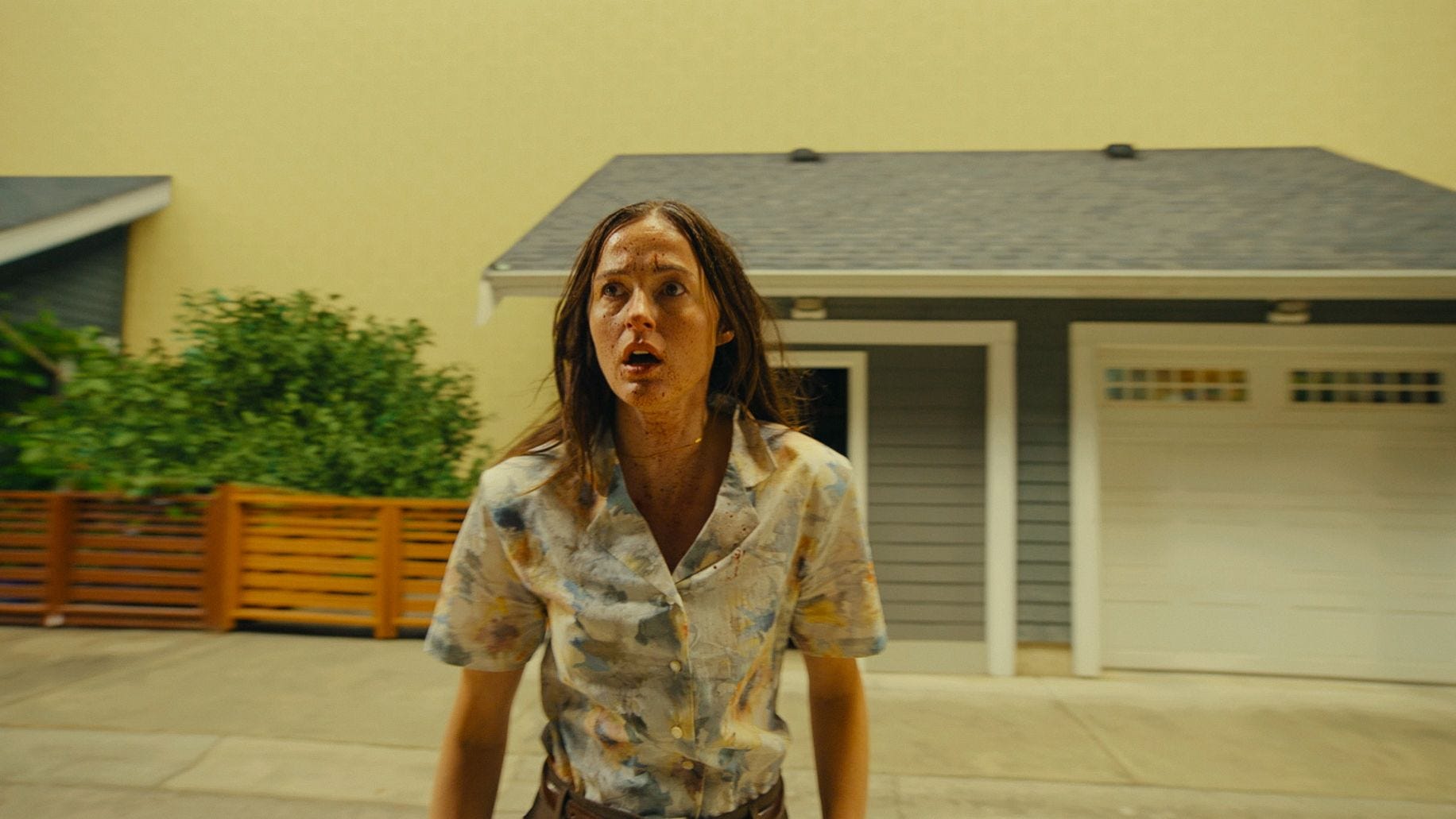
“We all have our loops. Our habits. Behaviors that keep us walking in circles. Reaching for the same solutions over and over again. Thinking each time will take you somewhere new, but they don’t.”
-Mary, Backrooms, 2026.
When Clark, a furniture store owner played by actor Chiwetel Ejiofor, stumbles through a basement wall in the horror film Backrooms, what he finds seems to be endless: rooms upon rooms that don’t make sense. Most appear to be storage for excess merchandise while others are more like suburban scenes randomly generated by AI. Water and tiles suggest one is a bathroom, but it doesn’t feel like one. A Christmas tree or a mini rocking horse implies a quaint living room or a baby’s room. But much like what Gemini summarizes when I’m researching, certain details always seem a little off.
In Backrooms, these spaces are horrifying for the way they mimic humanity back to itself across a landscape of commerce and excess, two elements that are deeply reflected in the Valley Girl1. Artificial and disturbingly sanitized, the rooms build behind a commercial enterprise in a salient commentary on suburbia, consumption, and the nuclear family.
📣 Spoilers below 📣
This commentary begins with an important and revealing rule immediately understood by the viewer. Clark, and later his therapist, Mary (Renate Reinsve), and younger employee Kat (Lukita Maxwell) and her partner Bobby (Finn Bennett), only have access the backrooms through the furniture store. They must cross the threshold into a commercial space (in a strip mall in 1990 San Jose, no less) in order to enter this alternate dimension. You have to literally and metaphorically engage with commerce to enter the backrooms.

These essential themes of white, middle-class aspirations centered around consumption echo the ideals of suburbanites seeking normativity across the U.S., including in the San Fernando Valley. Clark, who is Black, confides in his therapist, Mary, the way that he chronically fails at achieving these ideals. (These racialized themes across white suburban ambition mirror significant history in the Valley.) Clark’s now estranged wife, Nora, wanted children—a goal that would require him to work even longer hours to generate more income. This angers him because Nora is critical of how late he works at the furniture store, a cyclical problem in the now-failed heterosexual marriage. There is no way forward without working more, and yet working more is what impedes progress. Caught in this capitalistic loop, Clark drinks to cope with his middle-class frustrations and lack of agency, yet another critique by Nora.
The suburban home is revisited again and again as a place of fear. As Clark and Mary navigate the backrooms, it’s frequently the quaint, more saccharine nuclear family markers that serve as an inflection point for terror: a lit Christmas tree in the dark, a toddler’s rocking horse, a sit down dinner in a suburban kitchen. These domestic details and settings tellingly hold the tonal shifts in Backrooms; the moments that shift from eerie to scary.
The suburban home is revisited again and again as a place of fear.
Similarly, Mary is haunted by her own household dynamic, but as a child. Her girlhood memories of being raised by a mentally-ill mother are never expounded on in dialogue with other characters, but much like in real life, exist only in memory. Viewers see her as a child, terrified in her suburban living room papered up with newspaper over the windows. Her mother lambasts her for trying to leave, the sunlight just outside implying that this is not a typical safety concern; this is, much like the eerie randomness of the backrooms, something else. The living room is engineered to evoke a cozy, middle-class family life, but the visual of the newspapers is just off enough so as to convey something disquieting.
Like Clark, Mary’s familial life is one of dysfunction and unease, compounded with the unique vulnerability of a frightened child unable to leave these harrowing circumstances. Her childhood self is trapped here2, much like the backrooms themselves.

The juxtaposition of adults and children is deeply symbolic. Throughout the film, the navigation of the backrooms mirrors a nuclear family structure: Clark, the frustrated patriarch goes first. To travel the backrooms—the artifice, the endless consumption, and constant, ever-growing “more”—as a solitary Black man is terrifying. He later takes the “kids,” the younger employee Kat and her partner Bobby, assigned both male and female respectively. Lastly is Mary, who has already role-played in a therapy session as Clark’s estranged wife, and experiences the backrooms as a white woman within this family structure.
Mary and Clark continue to function as significant foils across gender and race. The climatical scene, in which Mary is forced to endure a terrifying “family dinner” with Clark in the suburban kitchen, solidifies the terror of this dynamic.
Throughout the film, the navigation of the backrooms mirrors a nuclear family structure
Against her will, she is forced to embody Clark’s wife again, another woman’s hair on her head. Mary is bound to a dining room chair as Clark wields a knife, physically harms others, and promises her that there is ultimately no consequence. He tells her that, despite the sinister tenor of the backrooms, “I like it in here. For the first time in a long time, I feel like I'm... Like I'm right where I'm supposed to be.” The frustrated patriarch finds personal solace (or something like it) in capitalism, homogeny, and predictability. Despite his own harm—alcoholism, chronic exhaustion, and failed creative ambition3—he ultimately would prefer to exist in this suburban capitalist matrix, a prevailing examination of comfort over radicalism.

This capitalism metaphor is taken even further when Clark explains to Mary that the people or beings within the backrooms aren’t really people at all. They exist to be used, consumed, even eaten if necessary. He tells her, “For starters, they can’t feel anything. Can you imagine how good that must feel? I mean, there’s no thoughts, no pain, no ego. No fear. They simply... exist. Like furniture.” The collapsing of people into unfeeling things and vice versa comes full circle with Clark’s comparison: they are like furniture, what he sells upstairs. People are essentially products.
But the most cutting criticism comes with the revelation that the ambiguous monster lurking in the backrooms is, in fact, himself: a cartoonish, exaggerated version of Clark translated through the branding of the furniture store. What he fears and ultimately must outrun is this threatening, contorted self portrait. A Portrait of Dorian Gray-esque rendering, his true self perhaps, marred by the endless forces of commerce.🌴
Next week: Mall horror.
Want to talk about this piece with me and other readers? Valley Girl Office Hours, for paid subscribers only, is on Friday, July 10th, from 2-3 pm PT (please note the time change). Drop by whenever and chat with me about the source material, the analysis, or any other inquiries.
Uppercase “Valley Girl” to indicate the manufactured caricature.
In the opening scenes of the film, Mary is captured as an adult watching the demolition of her suburban childhood home.
Clark maintains throughout the film that he is an architect, implying that he began to run the furniture store out of practicality.