

Calabasas Confidential
Meet you at The Commons

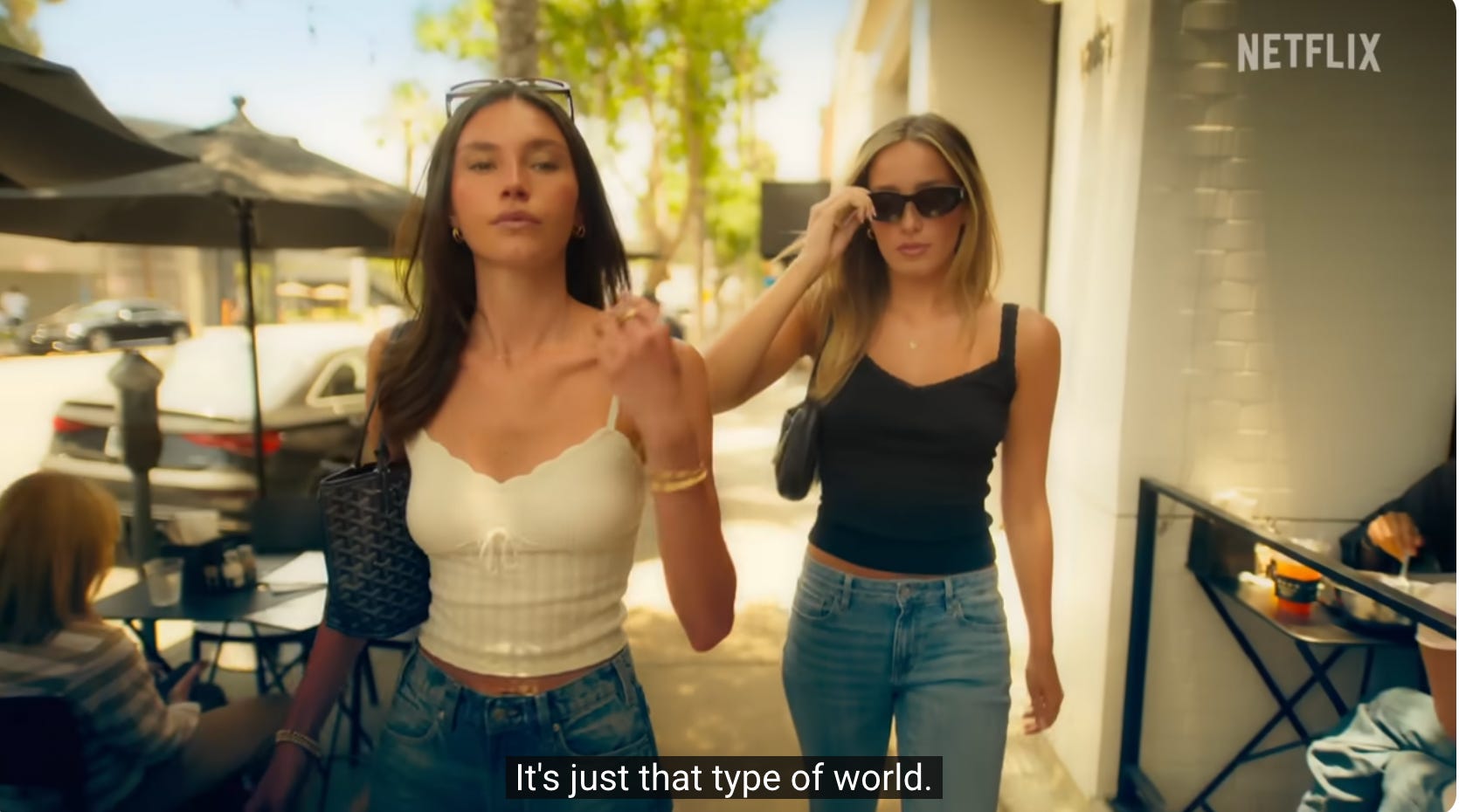
“I'm not going to be upset over a girl that’s unemployed and lives in the Valley.”
-Suede Brooks, Calabasas Confidential, 20261.
Calabasas Confidential, the reality TV series on Netflix about Gen Z high school friends “reconnecting” in their early 20s, answers the age old question: what ever happened to the wealthiest, thinnest, cruelest girl you went to high school with? In a lot of ways, this is a dated quandary. A quick glance at social media might confirm what you already know, but Netflix has a compelling thesis: she’s a twenty-something-year-old influencer pursuing modeling, Erewhon smoothies, pilates classes, and roaming somewhere between the Hollywood Hills, Calabasas, and Malibu.
In other words, she’s a Valley Girl2. The series explores, amplifies, and continues the Valley Girl gender trope right into 2026.

Filmed in Calabasas3 as well as other areas in and around the San Fernando Valley, the aesthetic of Calabasas Confidential, blends the light of Malibu with the glistening of at-home swimming pools in the Hidden Hills. As a viewer, you’re dropped into restaurants like Steak Blvd in Sherman Oaks and then back up to Calabasas for coffee at The Commons4, a well-known, bougie outdoor mall. The rhythm of the show is both distinctly of the 101 freeway—driving to the beach and back in the same day—and of constant consumption. Buying lunch, buying coffee, buying drinks, this the low hum that moves every scene forward and transitions to the next. Conversely, when the Valley Girls (or their male counterparts) aren’t buying, they are generating social media content for consumption: modeling shoots or “Get Ready With Me” videos.
Much like the Valley Girl of the 1980s, Calabasas Confidential characters have exactly three locations: the beach, the mall, and their upper-middle-class homes. This trinity echoes the messaging of the 1980s, in which the Valley Girl was positioned as either shopping or lounging, an “unserious” lifestyle of beaches and insatiable purchasing. What modernizes these themes are the dynamics of social media.
As I wrote before, the influencer is a 2.0 Valley Girl regardless of her region. She is a professional consumer who advises others on the best products to consume, even echoing valley girl 5dialect as she rattles through her various “hauls.” A number of the Calabasas Confidential Valley Girls are full-time influencers and have been creating fashion and/or beauty content for years. (Cast member Suede Brooks says she started creating content at age 12. She’s now 25.) This highly gendered relationship between consumption and the Valley Girl is foundational and enduring.
In both 1986 and 2026, the Valley Girl is representative of robust economic influence; she is emblematic of millions (if not billions) of dollars in American spending, whether it’s at the Galleria shopping mall or on a personal Instagram account. She is commerce and commerce is her, as each female cast member is clearly a business empire unto herself.
Among them is Nicole Sahebi, a 22-year-old Persian6 daughter of immigrants who effectively straddles the very complex space of being both a Valley Girl and a valley girl. Raised in Calabasas, a notoriously upper-class white neighborhood7, she speaks in a kind of coded racial awareness of her parents’ “sacrifices.” As a wildly successful influencer, Nicole tours luxury homes to potentially buy with money she has earned, in awe of the autonomy her social media career has afforded her. But even as she speaks with pride, there is a distinct fracturing between her origins and her success, saying, “my parents didn’t move to America so I could post TikToks.”
This racialized space is often visually articulated on screen. As Nicole sits with a trinity of blonde white girls at The Commons for coffee in the whitest neighborhood in the San Fernando Valley, I wonder what she is actually thinking. The geo racial politics of her existence in the Valley radiate backwards and forwards over low-rise jeans, fresh manicures, and TikTok updates. But no one says anything. This is the reality TV equivalent of the adage “saying the quiet part out loud.”
Other class differences play out the way they always have, echoing a persistent regional hierarchy. True to Valley tradition, Suede, a model and influencer who has reportedly been romantically involved with older, famous musicians and is very over-the-hill8 coded takes a swipe at Calabasas-based Jemma Durrant for being “a girl that’s unemployed and lives in the Valley.” The dichotomy is an old one: sophisticated, wealthy, well connected women and girls from Beverly Hills, Bel Air, and West Hollywood et al. reminding valley girls that they are basic, suburban, and cheap. This contention focuses on a shared male love interest, but poignantly, you could remove him and the regional dynamics across gender would be the same.
Given how well Jemma performs the Valley Girl gender trope, she is a clean target. Tall and blonde, she jokes about getting into sex work in front of her parents. She plays up “airhead” and “bimbo” responses when her father asks if she has filed her taxes. With a friend, she references perhaps getting a “boob job” to celebrate her promotion.
She knows exactly what audiences expect from her. She’s a Valley Girl.🌴
Next week: Pride.
Want to talk about this piece with me and other readers? Valley Girl Office Hours, for paid subscribers only, is on Friday, June 26th, from 12-1 pm PT. Drop by whenever and chat with me about the source material, the analysis, or any other inquiries.
“Calabasas Confidential.” Season 1, episode 4, 2026.
Uppercase “Valley Girl” to indicate the manufactured caricature.
Calabasas is a neighborhood in the San Fernando Valley.
The Commons was even popular with Calabasas teenagers back when I was in high school, circa 2005.
Lowercase “valley girl” to indicate a female-identified or pangender individual who happens to be from or inhabits the San Fernando Valley.
In her Instagram bio, Nicole writes that she is “just a persian girl in LA.”
“Demographic Information | City of Calabasas, CA.” City of Calabasas, www.cityofcalabasas.com/our-city/about-us/demographic-information. Accessed 25 June 2026.
“Over the hill” is an expression I used to hear my grandmother use when referencing anything over the Santa Monica Mountains.