

The Camps
Past is prelude

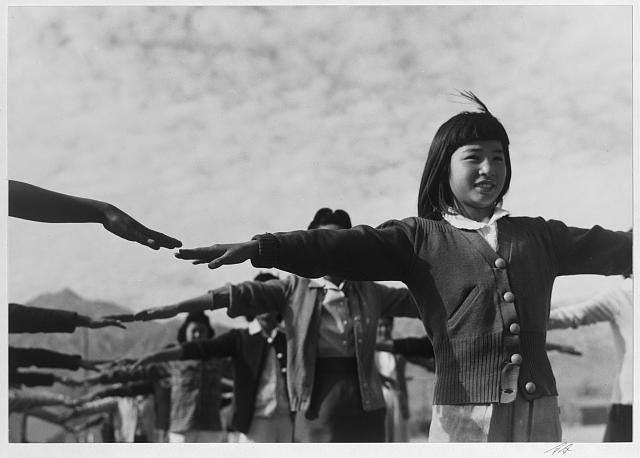
“My mother was devastated because the neighbor who lived three blocks away, her husband was taken away into prison camp or whatever. Not the camp like we went. The FBI came and just took 'em away. And so my mother was afraid that my father was gonna be taken away.”
-Sumiko Yamauchi on when her family and neighbors had to start reporting to “relocation centers” in 1942, July 23, 20131.
As valley girls2 and their families started to get notices to report to “relocation centers,” details about their new living conditions were murky. For the immigrant families who had to sell their life’s work and booming capital in a new country, they were given sometimes mere days to relinquish any property, valuables, and coordinate travel accordingly.
After Pearl Harbor, Sumiko Yamauchi, a then 14-year-old valley girl whose Japanese parents farmed flowers, remembers her mother starting to pack. Her parents had begun speaking with neighbors about what anyone knew and what they could expect. She would hear them on the phone in Japanese always arrive at the same conclusion: “Well, what can we do? We just have to go.”

In an oral history interview, Sumiko specifies that nobody ever personally communicated traveling logistics to her family. Her parents were sent a tag with a number on it and given a location of “a Greyhound bus, dozens and dozens of them, and you had to go walk down and see where your number matched this bus that you were on.”

In the face of this sweeping unconstitutional incarceration—and unaware of what awaited her children— Sumiko remembers her mother mandating that she and her siblings dress in their Sunday best and wear new shoes to board the bus. “We didn’t know whether we were gonna all be together,” Sumiko recalled. “And we were all, fortunately we were all in the same bus. And we were, we kind of knew where Manzanar was, but we didn’t know what it was like.”
They learned very quickly. Manzanar War Relocation Center3, based in Inyo County, California, is about four hours outside of Los Angeles by car. The open and dry area had been drained of its natural resources by the Los Angeles Aqueduct4 . Sumiko remembers arriving during a brutal dust storm to a meal of a hotdog and bread. The living conditions were bleak: when she and her family found their room, there was nothing there for them but an army cot. Upon arrival, prisoners were given a canvas bag and told where to stuff the bag with hay. This would suffice as their bedding:
Fortunately they did give us a couple of wool blanket[s] which was nice and warm. We used the one to cover the bed, and used the other to cover ourselves. And we had to actually cover our heads because the wind was blowing so hard, the barrack wasn’t finished yet, the wind was blowing in and the dust was coming in. And you walked on the floor, and the floor had openings and the wind was blowing through there, and it was whistling all night. You had the lights going, and searchlights going back and forth in the window, through the window, and you had to hear the jeeps going up and back. It was really a nightmare that first night, and I thought to myself, “Oh my gosh, what are we into?” I think that was the most scary thing there was, was trying to, that first night, everything is very strange anyway. And I think that dust was coming in, and when we got up, our blanket on top was just thick with dust. I don’t know, I think... we thought nothing could get any worse than this.5
Sumiko was right in her assessment that her barracks wasn’t yet completed. Historians now identify Manzanar, and other camps like it, as “makeshift”6 with “terrible” living conditions.
Eighty years later, another generation of Californians are enduring similar conditions under institutionalized white terror. ICE immigration stops of non-white people, which the Supreme Court affirmed is legal in Southern California7, continue to grow. As do the number of arrests. Last month, L.A. TACO reported that detainees at the Otay Mesa Detention Center near San Diego were strategically throwing tiny shampoo bottles to organizers outside. Inside the bottles, organizers found handwritten notes detailing horrendous living conditions. One detainee who has been imprisoned with his wife since April 2025 wrote:
“It’s cold here all the time and the food is poor,” the missive continues. “For 280 days we haven’t eaten a single piece of fruit, banana, apple, orange, or anything fresh. We are all in one big room with no doors or windows. We can’t see any grass or trees. We are all constantly sick.”8
Other notes detail very limited or no access to legal counsel, endless case postponement, and English-only resources. The facility is suspected to be exceeding capacity; the limited data available would confirm it. Immigration arrests in San Diego increased 1,500 percent between May and October of 20259.
Eighty years later, another generation of Californians are enduring similar conditions under institutionalized white terror.
Much like the Japanese incarceration of the 1940s, what is happening in California is indicative of a broader reality: as of January 2026, a record high of 73,000 people are being detained by ICE across the United States10. And similar to the last time our nation did this, the aggressive strategy has yielded a 2,450 percent increase in the number of people with no criminal record being held in ICE detention on any given day11. Some are even American citizens.
The glut in funding for these incarcerations from the One Big Beautiful Bill Act means that more locations are needed. In February 2026, The Guardian reported that ICE is scouting industrial warehouses to use as detention centers for anywhere from 1,000 to 10,000 people12. ICE documents suggest that the federal agency plans to “channel individuals into a network of large centralized facilities where they would remain until deportation.”
The aerial view of a warehouse in Social Circle, Georgia looks like Manzanar.🌴

Next week: coming home to nothing.
🧁In April, Valley Girl will celebrate her first birthday. Our girl is an Aries. To commemorate the occasion, I will be launching a paid tier of Valley Girl that month that will put some pieces behind a paywall. I’ll also be launching Office Hours, a weekly video meeting with me to discuss the week’s essay with paid subscribers. To enjoy uninterrupted content and all forthcoming features, please be sure to “pledge” a paid subscription.
Peterson, Whitney. “Sumiko Yamauchi Interview.” Densho Digital Archive, Manzanar National Historic Site Collection, 23 July 2013, Accessed 4 Mar. 2026.
Lowercase “valley girl” to indicate a female-identified or pangender individual who happens to be from or inhabits the San Fernando Valley.
As a valley girl, my initial understanding of Japanese incarceration came from the memoir Farewell to Manzanar by Jeanne Wakatsuki Houston, which was part of my middle school curriculum under LAUSD.
“There and Back: Los Angeles Japanese and Executive Order 9066.” There and Back: Los Angeles Japanese and Executive Order 9066, www.lapl.org/collections-resources/blogs/lapl/there-and-back-los-angeles-japanese-and-executive-order-9066. Accessed 25 Feb. 2026.
Peterson, Whitney. “Sumiko Yamauchi Interview.” Densho Digital Archive, Manzanar National Historic Site Collection, 23 July 2013, Accessed 4 Mar. 2026.
The National WWII Museum. “Japanese American Incarceration” https://www.nationalww2museum.org/war/articles/japanese-american-incarceration. Published March 4, 2026. Accessed March 4, 2026.\
25A169 Noem v. Vasquez Perdomo (09/08/2025), www.supremecourt.gov/opinions/24pdf/25a169_5h25.pdf. Accessed 4 Mar. 2026.
Wallace-Palomares , Aisha. “Exclusive: Detention Center Captives Are Throwing Lotion Bottles Wrapped With Notes to Organizers Outside Otay Mesa Facility.” L.A. TACO, 5 Feb. 2026, https://lataco.com/captive-lotion-bottle-note. Accessed 4 Mar. 2026.
Brennan, Deborah. “California Lawmakers Blocked from Entering Otay Mesa Detention Center despite Prior Clearance.” CalMatters, 21 Feb. 2026, calmatters.org/politics/2026/02/otay-mesa-inspection-lawmakers-denied/.
Montoya-Galvez, Camilo. “Ice’s Detainee Population Reaches New Record High of 73,000, as Crackdown Widens.” CBS News, CBS Interactive, 16 Jan. 2026, www.cbsnews.com/news/ices-detainee-population-record-high-of-73000/.
“New Report Details Ice’s Expanding and Increasingly Unaccountable Detention System.” American Immigration Council, 4 Feb. 2026, www.americanimmigrationcouncil.org/blog/ice-expanding-detention-system/. Accessed 4 Mar. 2026.
Campell, Lucy, and Marina Dunbar. “ICE to Spend $38bn Turning Warehouses into Detention Centers, Documents Show.” The Guardian, 13 Feb. 2026, https://www.theguardian.com/us-news/2026/feb/13/ice-warehouses-detention-centers-dhs. Accessed 4 Mar. 2026.