

Coming Home
When you don't have one

“There was a lot of farmers in the San Fernando Valley that lost everything. It’s terrible.”
-Roy Muranaka on what Japanese Americans returned to after WWII ended, March 23rd, 20041.
When WWII ended in the fall of 1945, Japanese-American incarcerates were notified that they could finally leave the makeshift camps. After immigrating to the United States, establishing successful and sustainable businesses, and then given sometimes mere days to sell their growing capital at a loss, the question loomed: where would these valley girls2 and their families live? Turns out, the U.S. government didn’t give this inquiry too much long-term thought either.
By the time the war had ended, many prisoners had been incarcerated for three to four years. In that time, property had passed hands, lucrative farms had fallen into disarray or to other owners entirely. By 1945, there weren’t always homes to go back to.
Jane Muranka, a valley girl whose family ran a flourishing flower farm, remembers that her father was allowed to leave Manzanar earlier than others to get his enterprise in order. They were an anomalous case: “I don't think anyone else came, in fact, I know that a lot of families didn't have anywhere to go, so they tried to prolong their stay at the camp.”3

This sudden need for housing could not have come at a worse time. Post-WWII saw a massive housing shortage already; the population of Los Angeles had surged to accommodate those recruited for aircraft manufacturing4 and GIs returning home (some of whom were Japanese-American themselves). The numbers were both staggering and deeply competitive: about one out of every 100 Americans (more than 1.3 million people) moved to California between 1940 and 19445. And after years of racist propaganda during the war, homeowners and lenders weren’t eager to step in and help such a maligned population. Redlining6 remained an open, legal, and rampant practice.
Hayako Kihara recalled in an oral history archive that, after WWII, she and her family attempted to buy a house in the San Fernando Valley. Ideally, they wanted to be in the Granada Hills area. Their real estate broker reframed his services along what he would and would not do: “He says I won’t look for anything on the other side of Sepulveda. You better buy something that’s on this side of Sepulveda,” Hayako recalled in 20047.
And by “this side of Sepulveda,” he most likely meant the Pacoima area, a Valley neighborhood that was already being designated for Black and Mexican families. The undesirables—families that weren’t white and/or middle-class—would be relegated to one area so as to protect growing property values of white suburbia above all else.
For most incarcerated valley girls and their families, though, the question of housing remained much more urgent than eventual home ownership. There was literally nowhere for them to go upon release. Racists would not even rent to them, let alone sell. The U.S. Government, eager to close down the camps, erected temporary housing all across Los Angeles: army barracks, airfields, and trailer parks.
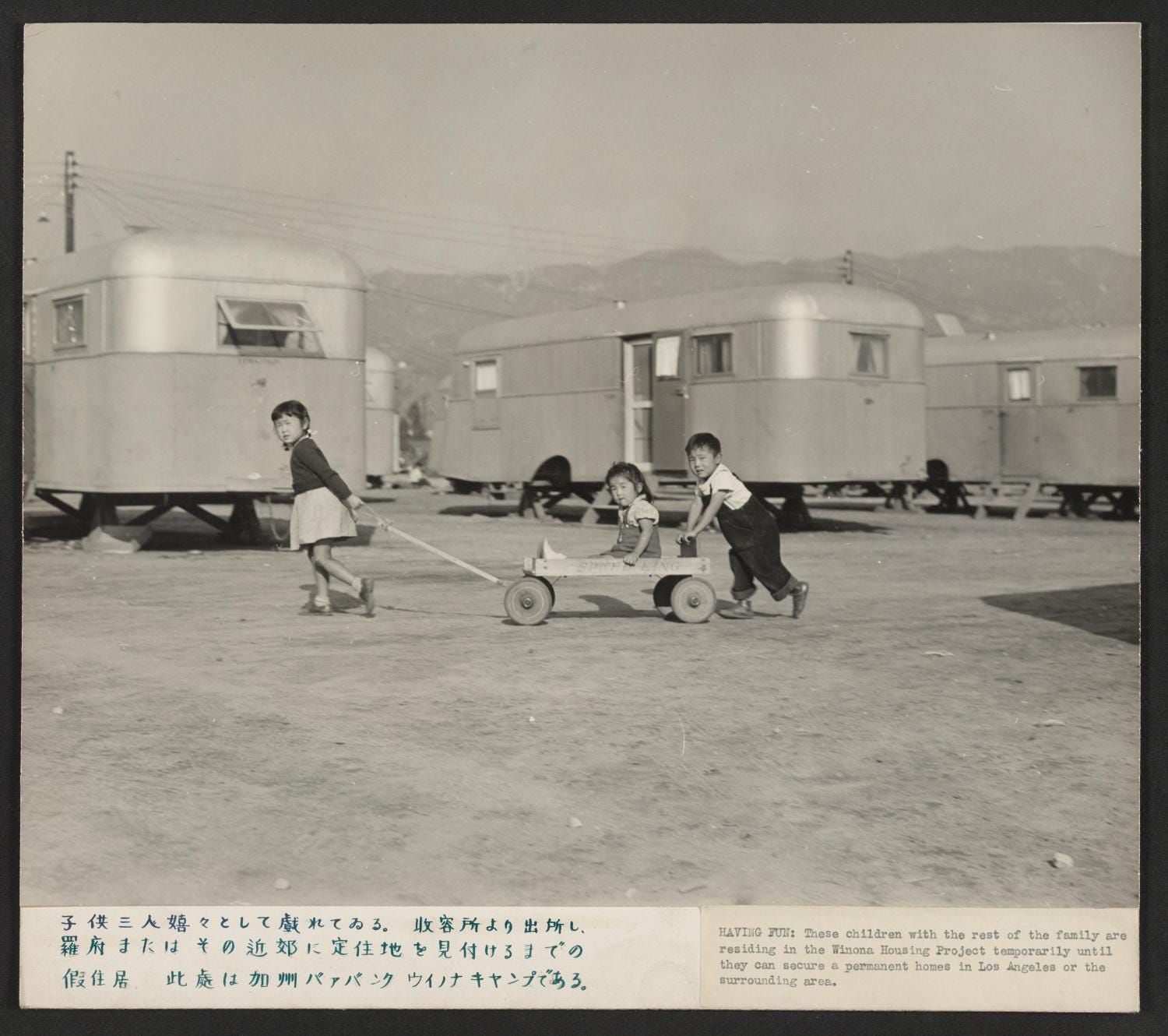
At the very edge of the Valley in Burbank, the War Relocation Authority erected a trailer park known as the Winona Housing Project. This would be the largest temporary housing for Japanese Americans in Southern California: within a month of opening, Winona became home to 478 “returnees.”8
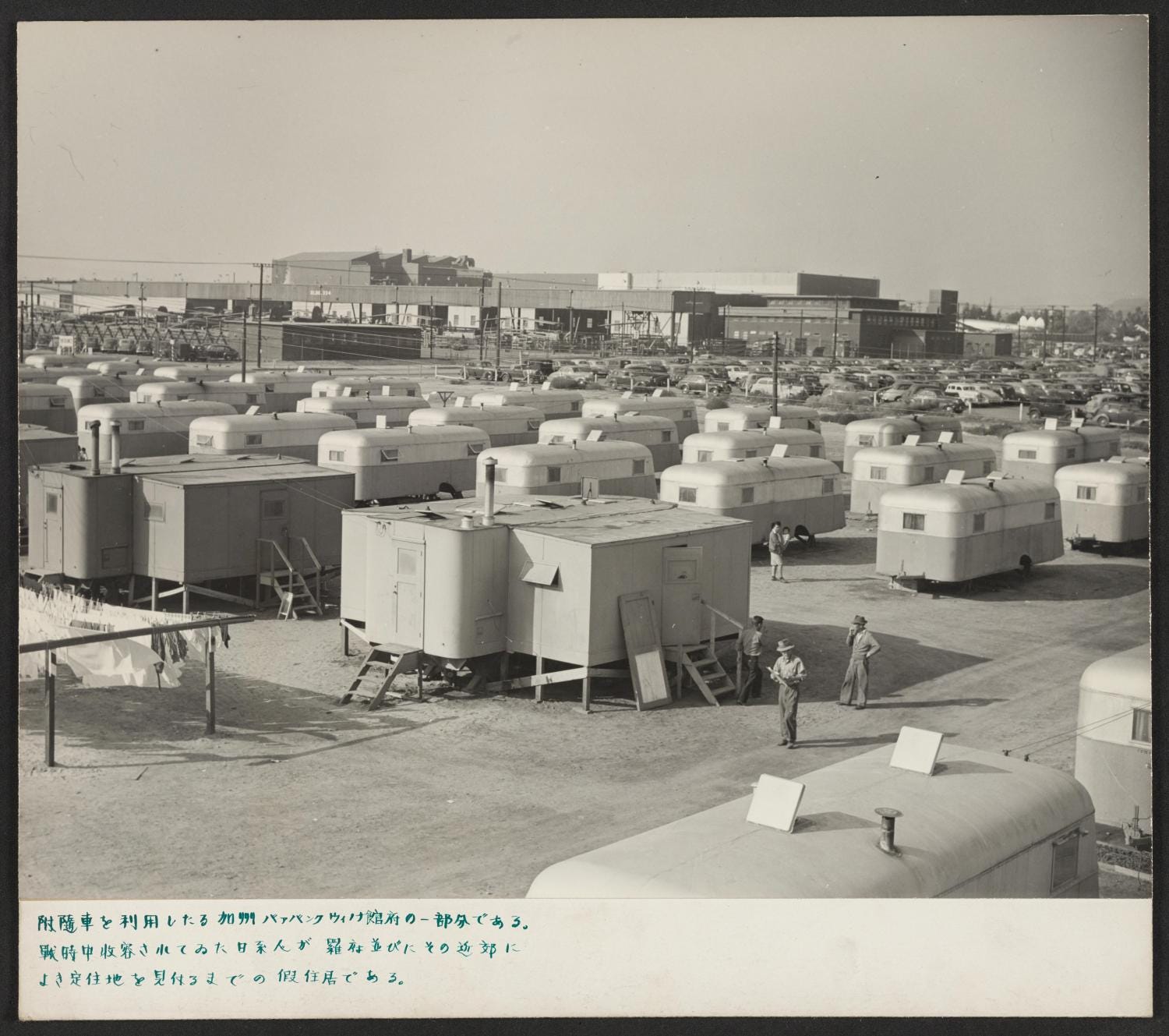
Much like the camps from which these families had just been released, the conditions were hardly livable. Burbank officials confirmed that Winona did not meet building code. There were frequent power outages, little access to medical resources, and not enough storage space. With racism towards Japanese Americans still at a fever pitch, employment opportunities were just as scarce as housing. This inability to retain employment meant the families of Winona could not secure the means to procure permanent housing. Meanwhile, the U.S. government wanted to move on from the racist housing shortage they promoted. The War Relocation Authority, and the support that came with it, would soon be disbanding, despite the over 2,000 Japanese Americans still living in emergency trailer camps.
The post-WWII “prosperity” that is often espoused in historical narratives did not extend to these valley girls and their families.
Winona would eventually become a “long-term housing facility” for families in need, but only after the Federal Public Housing Authority and the War Relocation Authority uprooted Japanese Americans yet again. About five hundred residents were sent to other camps further south of Los Angeles while the Winona Housing Project was refashioned to accommodate 1,000 residents (or 300 trailers). In addition to the indignity of being moved again, families were charged for this effort; the trailers did not have wheels and so the Federal Public Housing Authority offered to move them for $25 (a third of what the trailers were even worth.)
When they returned to Winona—often their fifth “relocation” in less than six years—they encountered conditions that brought them right back to the incarceration camps: insufficient sewer lines, little to no light, no cooking facilities, no gas, no heat. The situation was so bad that food couldn’t even be prepared on the premises. The Red Cross had to deliver meals prepared elsewhere. A resident is quoted in a 1946 federal report as saying, “It is worse than a relocation center."9
And yet, still, Winona residents made an optimistic effort at homemaking, according to this scene in The New York Times Magazine:
The process of rebuilding began again: new children, more gardens, renewed hope for stability. Homeowners erected picket fences around their tiny trailers, and this time the move stuck. For the next eight years the corner of San Fernando Road and Olinda Street was a bustling Japanese-American community.10
The post-WWII “prosperity” that is often espoused in historical narratives did not extend to these valley girls and their families. Their losses during the war would continue to ripple out in generations of poverty, financial instability, and losses. In 1983, a congressional commission investigation estimated that total property loss due to Japanese incarceration amounted to $1.3 billion11. The net income loss would be about double that: $2.7 billion. It was probably much higher.
And yet, even when Congress agreed to offer partial restitution, along with a formal apology, the best they could come up with was $20,000 to each formerly incarcerated person.🌴
Next week: Janet Jackson.
🧁In April, Valley Girl will celebrate her first birthday. Our girl is an Aries. To commemorate the occasion, I will be launching a paid tier of Valley Girl that month that will put some pieces behind a paywall. I’ll also be launching Office Hours, a weekly video meeting with me to discuss the week’s essay with paid subscribers. To enjoy uninterrupted content and all forthcoming features, please be sure to “pledge” a paid subscription.
“Japanese American Farmers in the San Fernando Valley before and After WWII Oral History Project.” TELLING OUR STORIES, CSUN, Department of Asian American Studies, 2004, Accessed 18 Feb. 2026.
Lowercase “valley girl” to indicate a female-identified or pangender individual who happens to be from or inhabits the San Fernando Valley.
Uyeno , Machiko and Tiffany Cheng. “Japanese American Farmers in the San Fernando Valley Before and After WWII Oral History Project.” San Fernando Valley Japanese American Community Center I California State University at Northridge , CSUN, Department of Asian American Studies, 23 Mar. 2004, Accessed 18 Feb. 2026.
“Winona Trailer Camp | Densho Encyclopedia.” Densho, encyclopedia.densho.org/Winona_trailer_camp/. Accessed 10 Mar. 2026.
Pearson, Bradford. “For Japanese-Americans, Housing Injustices Outlived Internment.” The New York Times Magazine, 20 Aug. 2020, https://www.nytimes.com/2020/08/20/magazine/japanese-internment-end-wwii-trailer-parks.html. Accessed 10 Mar. 2026.
The discriminatory practice of denying financial services, like mortgages, loans, and insurance, to people based on race or residency within a certain neighborhood.
“Japanese American Farmers in the San Fernando Valley before and After WWII Oral History Project.” TELLING OUR STORIES, CSUN, Department of Asian American Studies, 2004, Accessed 18 Feb. 2026.
“Winona Trailer Camp | Densho Encyclopedia.” Densho, encyclopedia.densho.org/Winona_trailer_camp/. Accessed 10 Mar. 2026.
Tom Sasaki, Reports #5 (”Lawyer Hangs Out His Shingle”), July 25, 1946 and #6 (”Winona Trailer Camp”), July 26, 1946, Japanese American Evacuation and Resettlement: A Digital Archive, The Bancroft Library, University of California at Berkeley. Accessed on 10 March 2026. http://digitalassets.lib.berkeley.edu/jarda/ucb/text/cubanc6714_b315w02_0011_1.pdf .
Pearson, Bradford. “For Japanese-Americans, Housing Injustices Outlived Internment.” The New York Times Magazine, 20 Aug. 2020, https://www.nytimes.com/2020/08/20/magazine/japanese-internment-end-wwii-trailer-parks.html. Accessed 10 Mar. 2026.
“Executive Order 9066: Resulting in Japanese-American Incarceration (1942).” National Archives and Records Administration, National Archives and Records Administration, www.archives.gov/milestone-documents/executive-order-9066. Accessed 25 Feb. 2026.